
 Home


How Elintree Redesigned Adult Pull-Up Diapers for Argentine Customer
📑 Table of Contents ▼ click to expand/collapse
- Introduction
- Project at a Glance
- 1. Understanding the Customer's Main Challenges
- 2. Upgrading the Absorbent-Core Configuration
- 3. Reviewing Leakage Protection and Fit
- 4. Reassessing the Product Dimensions
- 5. Upgraded Product Specifications
- 6. How Buyers Should Validate an Upgraded Adult Pull-Up Diaper
- 7. What This Case Shows About Adult Pull-Up Diaper Customization
- Developing a Customized Adult Pull-Up Diaper for Your Market? (CTA)
- Frequently Asked Questions
When adult incontinence products do not provide sufficient absorbency, leak during extended wear, or fit too tightly, the problem may involve more than one product specification. For brands and distributors, addressing these concerns requires a careful review of the absorbent core, leakage-protection structure, waistband design, and sizing.
An Argentine customer contacted Elintree after receiving feedback about an existing adult pull-up diaper. The main concerns were insufficient absorbency, leakage during nighttime use or extended wear, and sizing that felt too small for many consumers.
Elintree developed an upgraded product configuration around these requirements, covering absorbent materials, elastic structures, leakage guards, and product dimensions.
This case study explains the customer's reported challenges, the upgraded design, and the product checks buyers should consider before approving a customized adult pull-up diaper for bulk production.
Project at a Glance
-
Customer market: Argentina
-
Product: Adult pull-up diapers
-
Reported challenges: Insufficient absorbency, leakage concerns, and sizing that felt too small
-
Development focus: Absorbent-core configuration, leakage protection, waistband elasticity, and product dimensions
-
Stated absorbency of the upgraded product: 800–1,200 ml
-
Project approach: Customized product development based on customer feedback
The specifications below describe the upgraded configuration. Comparative test results and final customer approval have not been established in the information available for this case study.

1. Understanding the Customer's Main Challenges
The customer identified three issues with the existing product.
Insufficient absorbency
The customer reported that the product's absorbency did not meet expectations. For adult incontinence products, nominal absorption capacity is only one part of performance. Liquid intake speed, distribution through the core, and retention under relevant conditions also matter.
Leakage during nighttime use and extended wear
The customer also reported leakage during nighttime use or after longer periods of wear. Potential contributing factors can include the absorbent core, liquid distribution, leg-opening fit, and the effectiveness of the leakage barriers.
The exact cause cannot be determined from customer feedback alone. These factors therefore need to be considered during product development and sample evaluation.
Sizing that felt too small
According to the customer, many consumers found the existing product too small. This made sizing and fit another important development priority.
A suitable size range should provide adequate body coverage while maintaining appropriate contact around the waist and legs. Simply increasing the flat dimensions does not guarantee a better fit, so revised dimensions should be evaluated alongside elasticity and body coverage.
2. Upgrading the Absorbent-Core Configuration
One focus of the project was the absorbent structure.
The upgraded product uses a combination of tissue paper, imported U.S. fluff pulp, domestic superabsorbent polymer (SAP), and a white acquisition and distribution layer (ADL).
How the materials work together
-
Fluff pulp: Helps distribute liquid through the absorbent structure.
-
SAP: Absorbs and retains liquid within the core.
-
Tissue paper: Supports the absorbent assembly.
-
ADL: Helps receive liquid from the topsheet and distribute it toward the absorbent core.
The upgraded product has a stated absorbency range of 800–1,200 ml.
This figure should be interpreted according to the applicable test method. It does not, by itself, establish how many hours the product can be worn or guarantee overnight protection. Actual performance can also depend on liquid intake speed, rewet, distribution, fit, and the user's needs.
For B2B buyers, this is why absorbency specifications should be reviewed together with appropriate performance tests rather than used as the sole basis for product selection.


3. Reviewing Leakage Protection and Fit
The customer wanted to address leakage concerns as part of the product upgrade. The revised configuration includes several structural features intended to support containment and fit.
3.1 Three-dimensional leakage guards
The upgraded product includes 3D leakage guards around the leg area. These barriers are designed to help contain liquid and reduce the chance of leakage through gaps around the legs.
Their effectiveness depends on the guard construction, elastic tension, product fit, and use conditions. The design should therefore be evaluated on the finished product.
3.2 Elastic barrier cuffs
The barrier cuffs use three elastic strands on each side.
These elastics help the cuffs maintain contact with the wearer's legs. Their performance should be considered alongside cuff height, leg-opening dimensions, and the overall fit of the diaper.
3.3 Additional elastic features
The upgraded configuration includes:
-
Three elastic strands in the central rear section, described in the project specification as buttock-lift elastics.
-
One blue elastic strand on each side of the absorbent core.
-
A 360-degree elastic waistband.
These details form part of the customized construction. Their actual contribution to fit and leakage control should be assessed through sample evaluation, rather than inferred from the number of elastic strands alone.
3.4 A 360-degree elastic waistband
The upgraded product specifies the following front and back waistband elastic counts:
| Size | Front waistband | Back waistband |
|---|---|---|
| M | 17 strands | 17 strands |
| L | 18 strands | 18 strands |
| XL | 21 strands | 21 strands |
The front waistband specification also identifies eight blue elastic strands. Their exact placement and size-specific application should be confirmed in the final production specification.
Elastic strand count is only one part of waistband design. Elastic tension, recovery, bonding, and waistband dimensions can also influence the fit.
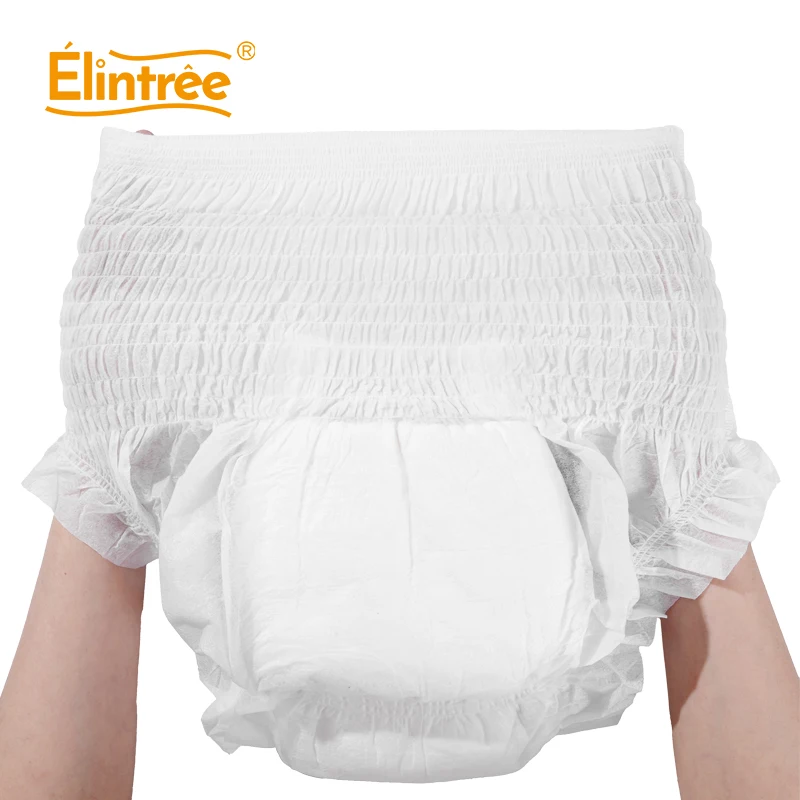
4. Reassessing the Product Dimensions
Sizing was another priority because the customer reported that many consumers found the existing product too small.
The upgraded specification includes three sets of product dimensions:
| Product dimension specification | Measurement |
|---|---|
| Dimension 1 | 760 × 590 mm |
| Dimension 2 | 800 × 710 mm |
| Dimension 3 | 880 × 850 mm |
The corresponding M, L, and XL labels have not yet been confirmed in the available project information. These measurements should therefore be treated as product dimensions, not as a verified size chart.
What buyers should check when reviewing adult diaper sizing
A practical fit evaluation should consider:
-
Waist and hip coverage
-
Leg-opening dimensions and elastic tension
-
Waistband stretch and recovery
-
Ease of putting on and removing the product
-
Comfort and coverage during different body positions
For products intended for a specific export market, buyer feedback and target-user measurements can help inform the size range.
Before mass production, the manufacturer and buyer should confirm the size mapping, measurement method, and acceptance criteria for the approved sample.
5. Upgraded Product Specifications
The following table consolidates the available specifications for the upgraded adult pull-up diaper.
| Component | Upgraded specification |
|---|---|
| Topsheet | Conventional spunbond nonwoven with diamond embossing |
| Backsheet | Unprinted composite film |
| Absorbent core | Tissue paper, imported U.S. fluff pulp, and domestic SAP |
| Acquisition layer | White ADL |
| Waistband | 360-degree elastic waistband |
| Front waistband elastics | M: 17; L: 18; XL: 21 strands |
| Back waistband elastics | M: 17; L: 18; XL: 21 strands |
| Leakage protection | 3D leakage guards |
| Barrier cuff elastics | Three strands on each side |
| Additional elastic features | Three central rear elastic strands and one blue elastic strand on each side of the absorbent core |
| Wetness indicator | Two lines, each 2 mm wide, with a specified spacing of 30 mm |
| Stated absorbency | 800–1,200 ml |
| Product dimensions | 760 × 590 mm; 800 × 710 mm; 880 × 850 mm |
This table summarizes the supplied design information. The final technical specification should confirm the size mapping, dimensional measurement convention, and exact placement of the colored elastic strands before production.
6. How Buyers Should Validate an Upgraded Adult Pull-Up Diaper
A detailed specification is an important starting point, but it does not replace product testing. Before approving a customized adult pull-up diaper, buyers should establish clear acceptance criteria with the manufacturer.
Absorbency and liquid handling
Confirm the method used to measure the stated absorption capacity. Where appropriate, assess intake speed, rewet, and liquid distribution under consistent test conditions.
Leakage protection
Evaluate leakage around the waist and legs using a defined test protocol relevant to the product's intended use. Nighttime-use requirements should be assessed separately where they are part of the product brief.
Fit and sizing
Check the approved size chart, body coverage, leg-opening fit, and waistband recovery. Sample evaluation should cover the sizes being developed.
Material and construction consistency
Confirm that the topsheet, backsheet, core materials, ADL, elastics, and wetness indicator match the approved sample and specification.
Sample approval before bulk production
The buyer and manufacturer should agree on the final specifications, packaging artwork, quality requirements, and acceptance criteria before mass production begins.
This process helps reduce ambiguity between the intended design and the finished product.
7. What This Case Shows About Adult Pull-Up Diaper Customization
The Argentine project illustrates a practical approach to customized adult incontinence product development: translate buyer feedback into specific design requirements, document the upgraded construction, and establish a clear process for sample validation.
For this project, the main development priorities were:
-
Reviewing the absorbent-core material combination
-
Specifying leakage guards and elastic features
-
Defining the waistband configuration
-
Reassessing product dimensions
-
Establishing the specifications that need to be confirmed before production
The upgraded configuration was developed around the customer's reported concerns. Whether it delivers measurable improvements must be established through appropriate testing and customer validation.
For brands, importers, and distributors, a clear technical brief and an agreed sample-evaluation process are important steps toward developing an adult pull-up diaper that fits the requirements of the target market.

Developing a Customized Adult Pull-Up Diaper for Your Market?
Elintree works with B2B buyers on customized hygiene-product projects, including adult incontinence products.
To discuss your project, share the information available about your target market, required sizes, absorbency expectations, leakage-protection requirements, packaging, and estimated order quantity.
Discuss Your Product Requirements with Elintree
Contact Elintree to review your specifications and discuss the next steps for customized product development.
Frequently Asked Questions
1. Can adult pull-up diapers be customized for a specific market?
Depending on the project requirements and manufacturing capabilities, customization may include absorbent-core construction, topsheet and backsheet materials, leakage guards, waistband design, sizing, and private-label packaging. Buyers should confirm the available options and minimum order quantity with the manufacturer.
2. Does an absorbency specification of 800–1,200 ml guarantee overnight protection?
No. A stated absorption capacity does not guarantee a specific wearing time or overnight performance. Test methods, liquid intake speed, rewet, fit, and the user's needs can all influence actual performance.
3. What should buyers check when evaluating adult pull-up diaper sizing?
Buyers should confirm the size chart and measurement method, then assess waist and hip coverage, leg-opening fit, waistband stretch, and comfort. The size labels should correspond to verified product dimensions and the approved sample.
4. What should be confirmed before placing a bulk order?
Confirm the product specification, size mapping, material construction, test methods, packaging artwork, quality requirements, and acceptance criteria. Where applicable, approve the final sample before starting mass production.
Looking for other adult care products? Explore our OEM range.
Ready to discuss your project? Contact our team.