
 Home


Adult Diaper Quality Checklist: What Buyers Should Check Before Bulk Orders
Buying adult diapers in bulk involves more than comparing prices and reviewing product samples. For importers, distributors, healthcare suppliers, and private-label brands, product quality must remain consistent across production batches, shipment quantities, and repeat orders.
A sample may perform well during evaluation, but that alone does not guarantee the same performance in mass production. Differences in raw materials, absorbent core construction, production settings, product dimensions, and quality control can affect the final product.
Before placing a bulk order, buyers should establish clear product specifications, verify the manufacturer’s quality management process, and agree on how finished products will be inspected.
This guide explains how to evaluate an adult diaper manufacturer, which materials and performance characteristics to check, what documentation to request, and how to establish a practical quality inspection plan.
📑 Table of Contents ▼ click to expand/collapse
- 1. Verify the Manufacturer's Qualifications and Quality Management System
- 2. Inspect Raw Materials Before Production
- 3. Evaluate Production Quality Control and Finished Products
- 4. Test Absorption Capacity, Absorption Speed, Rewet, and Leakage Performance
- 5. Evaluate Leakage Protection, Fit, and Comfort
- 6. Review Skin-Contact Safety and Chemical Compliance
- 7. Ensure Mass Production Matches the Approved Sample
- 8. Check Packaging and Establish a Pre-Shipment Inspection Plan
- 9. Final Adult Diaper Quality Checklist for Bulk Buyers
- Frequently Asked Questions
- Conclusion: Verify the Quality System, Not Just the Sample
- Looking for an Adult Diaper OEM or Private-Label Manufacturing Partner? (CTA)
1. Verify the Manufacturer‘s Qualifications and Quality Management System
Before evaluating individual products, confirm that the supplier has the manufacturing capabilities and quality controls required for your order.
A supplier may offer samples and certificates without manufacturing the products itself. Buyers should understand who actually controls production, verifies product performance, and takes responsibility for quality.
Manufacturer Verification Checklist
-
Factory identity: Confirm the legal company name, manufacturing address, and relationship between the supplier and production facility.
-
Product capabilities: Check whether the factory manufactures adult tape diapers, adult pull-up pants, or both.
-
Production capacity: Review relevant production lines, output capacity, and experience with similar products.
-
Quality management: Ask how incoming materials, in-process production, finished products, and shipment inspections are controlled.
-
Batch traceability: Confirm whether production dates, line information, material batches, and quality inspection records can be traced.
-
OEM experience: Verify whether the manufacturer can meet your product specifications, packaging requirements, labeling needs, and bulk production expectations.
How to Verify Certificates and Test Reports
Do not rely on certification logos alone. Request the relevant documents and check:
-
Whether the company name matches the supplier’s legal identity.
-
Whether the document covers the relevant factory, product, or activity.
-
Whether the certificate is valid and verifiable with the issuing organization.
-
Whether a test report identifies the product, sample, testing method, and testing organization.
-
Whether the documentation is relevant to the intended destination market and product claims.
A quality management certificate, product test report, and regulatory compliance document serve different purposes. One does not automatically replace the others.
Not every adult diaper is classified as a medical device. Applicable requirements depend on the product, intended use, claims, and destination market.
Buyer tip: Evaluate the manufacturer‘s quality management system alongside its certificates. Documentation is more useful when it demonstrates how quality requirements are applied to actual production.

2. Inspect Raw Materials Before Production
Raw materials influence absorption, liquid retention, leakage protection, comfort, durability, and skin-contact safety. Buyers should understand the main components and how their specifications are controlled.
| Material | What Buyers Should Check | Why It Matters |
|---|---|---|
| Superabsorbent polymer (SAP) | Grade, supplier, batch information, specifications, and available test documents | Influences liquid absorption and retention |
| Fluff pulp | Grade, appearance, supplier, and relevant specifications | Contributes to liquid distribution and core structure |
| Topsheet nonwoven | Material type, basis weight, softness, and specifications | Affects skin contact and liquid acquisition |
| Backsheet film | Material structure, thickness, integrity, and specifications | Helps prevent liquid from passing through the outer layer |
| Elastic materials | Dimensions, elasticity, recovery, and consistency | Affects fit and leakage protection |
| Hot-melt adhesive | Technical specifications, batch information, and relevant documentation | Helps bond the absorbent core and other components |
| Fastening materials | Adhesion, fastening function, and consistency | Affects adjustment and usability |
What Material Documentation Should Buyers Request?
Depending on the material and supplier, request:
-
Technical data sheets and approved material specifications.
-
Certificates of analysis or relevant test reports, where available.
-
Supplier identification and batch or lot numbers.
-
Material declarations and applicable chemical compliance documentation.
-
Records of significant material changes or substitutions.
Check that the documents match the actual material grade used in production. A report for a similar material does not automatically establish the quality of the material supplied.
Why the Supplier’s Brand Name Is Not Enough
A well-known SAP, nonwoven, or adhesive supplier does not automatically guarantee the performance of the finished diaper.
Results also depend on material grade, quantity, distribution within the product, compatibility with other components, and manufacturing conditions.
For private-label projects, buyers should agree on the approved material specifications and require notification before significant substitutions. This helps reduce the risk of changes in performance between the approved sample and subsequent bulk orders.
3. Evaluate Production Quality Control and Finished Products
Suitable raw materials can still produce inconsistent diapers if the manufacturing process is not properly controlled. Quality checks should therefore cover both production and finished products.
What Should Be Checked During Production?
Absorbent core formation
-
Is the core positioned correctly?
-
Is the distribution of SAP and fluff pulp consistent with the approved specification?
-
Are there visible gaps, uneven areas, or abnormal clumps?
-
Are core dimensions and product weight within the agreed limits?
Component positioning and bonding
-
Are the topsheet, backsheet, and absorbent core aligned correctly?
-
Are leg elastics and leak guards positioned properly?
-
Are waistbands and fastening tabs securely attached?
-
Is adhesive applied consistently without contaminating inappropriate areas?
Product dimensions and construction
-
Are product dimensions consistent with the approved size specification?
-
Are cuts, seams, and edges clean and consistent?
-
Are there damaged, folded, or incorrectly assembled components?
-
Are weight and other agreed specifications within tolerance?
Process monitoring and records
-
Are inspection results recorded by production batch or shift?
-
Can the factory identify the production line, date, and relevant material batches?
-
Are abnormal products isolated rather than mixed with conforming products?
-
Are corrective actions documented when recurring issues occur?
What Should Be Checked in Finished Products?
Inspect multiple units from different packs and, where practical, different cartons.
Check that products are clean, free from visible contamination, and consistent with the approved sample. Examine the core, leg cuffs, fastening components, product dimensions, weight, and overall construction.
Also verify that products open, unfold, fasten, and fit as intended.
Visual inspection is important, but it cannot establish absorption performance or leakage protection on its own. Functional testing is necessary when those characteristics are part of the agreed product requirements.
How Elintree Approaches Factory Quality Inspection
Elintree‘s quality management process covers incoming material inspection, in-process monitoring, laboratory and product testing, finished-product inspection, and traceability.
For a more detailed view of the inspection stages, testing categories, and laboratory equipment, visit the Elintree Quality Control System page.
Buyers can use this information as a starting point for discussing the specific quality checks and documentation required for their own adult diaper projects.
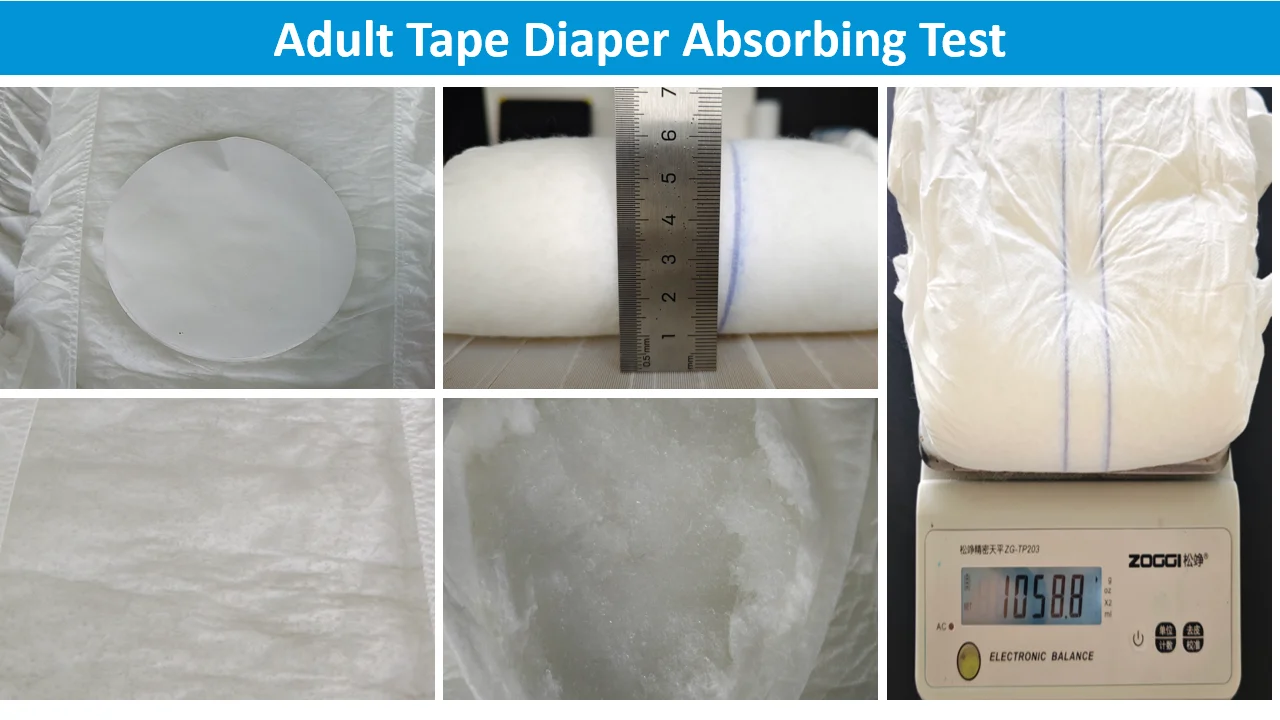
4. Test Absorption Capacity, Absorption Speed, Rewet, and Leakage Performance
Absorbency is a major factor in adult diaper performance, but it is not a single measurement. Buyers should distinguish between absorption capacity, absorption speed, liquid retention, rewet, and leakage-related performance.
Different tests measure different characteristics, so their results should not be treated as interchangeable.
Four Important Performance Measurements
1. Overall absorption capacity
This measures how much liquid a product can absorb under specified test conditions. It is useful for comparing products when the same method and conditions are used. However, maximum absorption capacity does not directly establish how long a diaper will remain comfortable or leak-free during actual use.
2. Absorption speed
This measures how quickly a specified quantity of liquid is absorbed under defined conditions. Faster liquid acquisition may help reduce the amount of liquid remaining on the surface. Results depend on the test method, liquid volume, and product construction.
3. Rewet
Rewet measures how much liquid returns to the product surface under specified conditions, often involving pressure or an applied load. A lower rewet result can indicate better liquid retention under the tested conditions. However, it should be evaluated alongside absorption speed, leakage protection, and intended use.
4. Absorption before leakage (ABL)
ABL evaluates how much liquid a product takes in before leakage occurs under a defined test procedure. It can provide useful information about leakage-related capacity, but the test method must be appropriate for the product type. Results should not automatically be compared across different diaper designs or testing procedures.
Which Standards Are Relevant?
Two useful references are:
-
ISO 11948-1 — describes a whole-product method for determining the absorption capacity of urine-absorbing aids.
-
ISO 15621 — provides general guidance for evaluating absorbent incontinence products.
The appropriate method depends on the characteristic being evaluated and the product’s intended use. A general evaluation guideline should not be confused with a specific performance test or a universal regulatory requirement.
How Should Buyers Compare Test Results?
Ask the manufacturer or laboratory to identify:
-
The test method and version.
-
The product model and size tested.
-
The number of samples tested.
-
The test fluid, liquid volume, and test conditions.
-
The measured results and agreed acceptance criteria.
-
Whether testing was performed in-house or by an independent laboratory.
For a fair comparison, test candidate products using the same method and comparable conditions.
Common mistake: comparing maximum absorption claims alone.
A claim such as “absorbs 2,000 ml” is incomplete without the test method and conditions. Maximum absorption capacity should not be interpreted as a guaranteed wearing time.
Instead, define requirements for the intended application, such as daytime use, overnight use, or care-facility use. Evaluate absorption capacity together with rewet, absorption speed, leakage protection, and fit.
5. Evaluate Leakage Protection, Fit, and Comfort
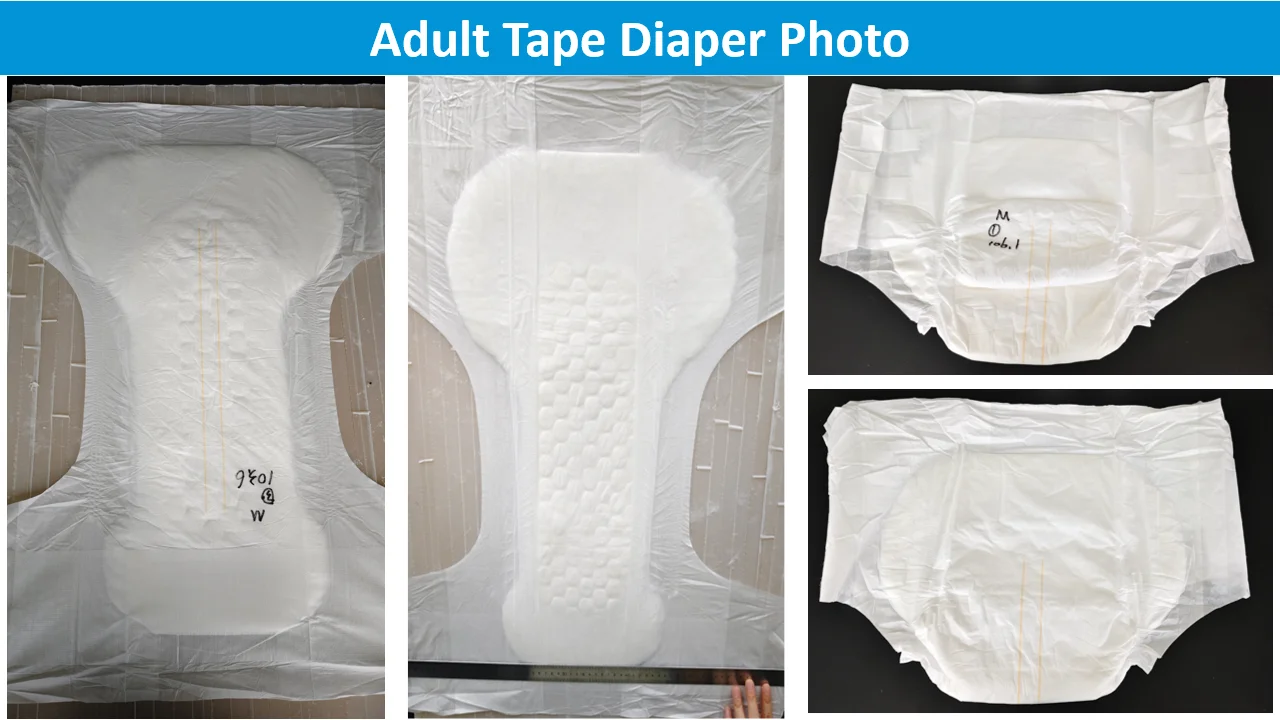
A diaper may have a high absorption capacity and still leak. Poor fit, incorrectly positioned leg guards, uneven core distribution, or unsuitable dimensions can all contribute to leakage.
Buyers should evaluate both product construction and performance under agreed test conditions.
Leakage Protection Checklist
Leg cuffs and barriers
-
Are cuffs present and correctly positioned?
-
Do elastic components recover appropriately after stretching?
-
Are barriers free from visible defects?
-
Is construction consistent across the inspected samples?
Backsheet integrity
-
Is the backsheet free from holes, tears, or obvious damage?
-
Are bonded areas intact?
-
Does the product show signs of leakage through the material or component joints during suitable testing?
Core and liquid distribution
-
Is the absorbent core positioned correctly?
-
Does the core show abnormal deformation or clumping after a defined use simulation?
-
Does liquid distribution contribute to leakage under the agreed test conditions?
Where appropriate, conduct controlled liquid-loading tests and wear evaluations suited to the target user and product type. Laboratory tests and real-use evaluations provide different kinds of evidence and should be considered together when necessary.
Fit and Usability Checklist
-
Size accuracy: Check waist, hip, leg, and other relevant dimensions against the approved specification.
-
Leg fit: Evaluate whether the openings fit the intended user profile without excessive gaps or uncomfortable tightness.
-
Waist fit: Check whether the waistband sits correctly and remains stable during movement.
-
Fastening: For tape diapers, assess fastening security and adjustment.
-
Elastic recovery: Check whether elastic areas return appropriately after stretching.
-
Comfort: Look for excessive bulk, stiff areas, rough edges, or construction features that may cause discomfort.
-
Ease of use: Assess putting on, removing, adjusting, and changing the product.
For pull-up pants, pay particular attention to waistband elasticity, leg openings, side seams, and ease of putting on and removing the product.
For tape diapers, evaluate fastening adjustment and fit across the intended range of body shapes.
ISO 16021 provides a framework for evaluating single-use adult incontinence products from the perspective of users and caregivers. It is a useful reference when product acceptability and usability are relevant to the evaluation.
Buyer tip: Do not approve a size based only on its label, such as M, L, or XL. Sizing conventions vary between manufacturers and markets. Confirm actual dimensions and evaluate fit against the intended user profile.

6. Review Skin-Contact Safety and Chemical Compliance
Adult diapers are worn close to the skin, sometimes for extended periods. Skin-contact safety and chemical compliance should therefore be considered during supplier qualification and product development.
However, buyers should avoid assuming that one generic allergy test can prove a product is safe for every user.
What Should Buyers Review?
Depending on the materials, product construction, intended market, and applicable requirements, consider:
-
Material composition and supplier declarations.
-
Applicable chemical compliance documentation.
-
Relevant test reports for substances of concern.
-
Skin irritation assessment where appropriate.
-
Sensitization assessment where appropriate.
-
Fragrance, lotion, or other added ingredients, if present.
-
Product-specific safety and compliance requirements in the destination market.
The EDANA Stewardship Programme for Absorbent Hygiene Products provides industry guidance on assessing certain trace chemicals in absorbent hygiene products.
ISO 10993-23 addresses irritation testing for medical devices. It should not automatically be treated as a universal testing requirement for every adult diaper; applicability depends on product classification and the relevant assessment framework.
How Should Buyers Evaluate “Hypoallergenic” Claims?
Do not accept unsupported claims such as “hypoallergenic” or “non-irritating” as a substitute for evidence.
Ask which product version or materials were assessed, what testing was performed, and what population or conditions the evidence covers.
No single test can guarantee that a product will never cause irritation or an allergic reaction in any individual.
Material certificates are important, but the assessment should consider the actual finished product and its component materials.
7. Ensure Mass Production Matches the Approved Sample
For OEM and private-label buyers, sample-to-bulk consistency is one of the most important quality controls.
A sample may not represent the conditions or materials used during mass production. Buyers should therefore establish a documented approval process before confirming a bulk order.
Step 1: Approve a Reference Sample
Keep an approved sample that represents the agreed product design and specifications.
Record the product type, size, materials, construction, packaging version, and relevant performance requirements. Where practical, retain a sealed reference sample with an approval date.
Step 2: Create a Written Product Specification
Do not rely on photographs, verbal descriptions, or a sample alone.
The specification should cover relevant details such as:
-
Product dimensions and tolerances.
-
Target weight or weight range, where agreed.
-
Core structure and key material specifications.
-
Waistband, leg cuffs, fastening, and other components.
-
Absorption, rewet, leakage, and other agreed performance criteria.
-
Packaging design, pack count, and labeling.
-
Test methods and acceptance limits.
Step 3: Check Actual Production Samples
Inspect samples from the actual production run and compare them with the approved reference sample and written specification.
Check construction, dimensions, weight, and agreed functional performance.
Step 4: Control Material and Process Changes
Require the manufacturer to communicate significant changes to materials, suppliers, product construction, production processes, or packaging.
Where a change may affect performance or compliance, agree whether evaluation or re-approval is necessary.
Step 5: Monitor Repeat Orders
Retain relevant inspection records and compare results over time. This can help identify gradual changes that may not be obvious when reviewing a single shipment.
Better practice: Treat the approved sample as a reference, not as the only evidence of quality. Written specifications, production records, batch inspection, and change control help establish consistency.

8. Check Packaging and Establish a Pre-Shipment Inspection Plan
Packaging defects can create problems even when the diapers themselves meet quality requirements. Incorrect pack counts, labeling errors, damaged bags, or unsuitable cartons may lead to customer complaints, customs issues, or distribution delays.
Packaging Inspection Checklist
Inner packaging
-
Correct product name, size, and design.
-
Correct number of pieces per pack.
-
Accurate product information and approved claims.
-
Correct language and labeling for the destination market.
-
Correct barcode or product code, where required.
-
Consistent packaging artwork and version.
-
Proper seals with no obvious holes, damage, or contamination.
-
Appropriate date, lot, or traceability information where applicable.
Outer cartons
-
Correct carton dimensions and quantity per carton.
-
Accurate carton labels and shipping marks.
-
Consistent product and size identification.
-
No significant damage, moisture, or contamination.
-
Packaging suitable for the agreed transport and storage conditions.
-
Correct quantities and carton counts against the packing list.
For private-label orders, compare the actual printed packaging against the approved artwork. Verify details such as size, pack count, barcode, claims, language, and market-specific information.
What Should a Pre-Shipment Inspection Cover?
Agree on the inspection scope before production or shipment. A practical plan may include:
-
Quantity verification: Confirm production and packing quantities against the purchase order.
-
Visual inspection: Check appearance, construction, cleanliness, and obvious defects.
-
Dimensional and weight checks: Compare sampled products with agreed specifications.
-
Performance testing: Verify agreed absorption, rewet, leakage, or other functional requirements using specified methods.
-
Packaging inspection: Check pack counts, carton labels, barcodes, and shipping marks.
-
Documentation review: Verify relevant batch records, inspection results, and compliance documents.
-
Defect classification: Record critical, major, and minor defects using agreed definitions.
How Should the Sampling Plan Be Defined?
Agree on the sampling method, sample size, inspection level, and acceptance criteria before inspection.
An AQL-based sampling plan may be appropriate for certain visual and dimensional checks, provided it is selected and applied correctly. AQL does not guarantee that a shipment contains a particular percentage of defective products, nor does it replace specific safety or performance requirements.
For specialized performance tests, define the number of samples, test conditions, methods, and acceptance limits separately where necessary.
Independent inspection may provide additional verification for new suppliers, new products, large orders, or high-risk shipments. It complements rather than replaces the manufacturer’s quality management system.
9. Final Adult Diaper Quality Checklist for Bulk Buyers
Before confirming a bulk order, use the following checklist to ensure the main quality requirements have been addressed.
- The factory‘s identity, production capabilities, and relevant qualifications have been verified.
- Applicable certificates and product compliance documents have been reviewed.
- Key raw materials and their specifications have been identified.
- Relevant supplier documents and material batch records are available.
- The manufacturer has documented production controls and traceability procedures.
- Finished products have passed agreed appearance and construction checks.
- Absorption capacity, absorption speed, and rewet have been evaluated where required.
- Leakage protection has been assessed using appropriate methods.
- Product dimensions, fastening, fit, and usability have been checked.
- Relevant skin-contact safety and chemical compliance requirements have been considered.
- A reference sample and written product specification have been approved.
- Sample-to-bulk consistency and material change control have been agreed.
- Packaging, labeling, barcodes, pack counts, and carton information have been verified.
- Pre-shipment sampling, defect classification, and acceptance criteria have been agreed.
- Procedures for handling nonconforming products and corrective actions are clear.
Not every product requires every specialized test. The final inspection scope should reflect the product design, intended use, destination market, applicable requirements, and risks associated with the order.
Frequently Asked Questions
What is the most important quality test for adult diapers?
There is no single test that proves overall product quality. Absorption capacity, absorption speed, rewet, leakage protection, fit, and construction each measure different aspects of performance. Select tests according to the product’s intended use and compare results obtained under consistent conditions.
Does higher absorption capacity mean a better adult diaper?
Not necessarily. A higher capacity figure does not automatically mean faster absorption, lower rewet, better leakage protection, or greater comfort. Evaluate the complete performance profile rather than relying on a maximum absorption claim.
How can buyers ensure bulk adult diapers match the sample?
Approve a reference sample, create a written specification, inspect samples from actual production, review batch records, and require communication about relevant material or process changes. Repeat-order quality should also be monitored over time.
Which documents should an adult diaper manufacturer provide?
Requirements depend on the factory, product classification, destination market, and product claims. Buyers should review relevant factory and quality management certificates, material documentation, test reports, and market-specific compliance evidence.
Is pre-shipment inspection enough?
No. Pre-shipment inspection helps identify defects in a shipment, but it cannot replace incoming material controls, production monitoring, batch traceability, or appropriate performance testing. A more reliable approach combines these controls.
Conclusion: Verify the Quality System, Not Just the Sample
Reliable adult diaper sourcing requires more than finding a supplier with competitive pricing and a good-looking sample. Buyers need evidence that the manufacturer can control materials, maintain consistent production, verify finished-product performance, and deliver the agreed specifications across bulk orders.
The most effective approach is to define requirements before production, verify relevant documentation, evaluate the product using appropriate test methods, and establish clear inspection and change-control procedures.
For brands, importers, distributors, and healthcare suppliers developing adult diapers or private-label incontinence products, these steps can reduce avoidable quality disputes and create a stronger foundation for repeat orders.
Looking for an adult diaper OEM or private-label manufacturing partner?
Before requesting a quotation, prepare your target product type, size range, performance requirements, destination market, and packaging specifications. Elintree can discuss these requirements as part of your product development and bulk manufacturing project.
Explore Elintree‘s OEM Adult Diapers & Pants service to discuss your product specifications, quality expectations, and private-label requirements.